
The memory that comes first
My grandfather bore a concentration-camp tattoo.That fact belongs at the beginning of anything I write about Nazi Germany.It is part of my family’s history, and it sets the moral context for this reflection.
I reject Nazism and neo-Nazism unequivocally.The persecution, dehumanization, and mass murder carried out by the Nazi regime were monstrous.An interest in military organization cannot soften that judgment.Nor should any discussion of uniforms, ranks, or administrative systems push the victims out of view.
There is also no historically sound way to separate an allegedly innocent military machine from the regime’s crimes.The United States Holocaust Memorial Museum documents the Wehrmacht’s participation in atrocities and the Holocaust.Its organization served a criminal war.That must remain part of the discussion whenever its methods are examined.[1]
What the appearance of order conceals
What has impressed me in military structures is their visible organization: defined roles, recognizable ranks, and the arrangement of many people into smaller, coordinated units.Such structures can look remarkably coherent.
But looking organized is different from being well organized.A clear hierarchy does not prove that decisions are wise, information is accurate, or resources are sufficient.It certainly does not make an organization’s purpose morally defensible.
That distinction matters when looking at Nazi Germany.Describing its military organization as “perfect” would turn an impression into a claim the historical record does not support.The image of an entirely mechanized, relentlessly efficient force leaves out much of the machinery that actually kept it moving.
Behind the machines, the horses
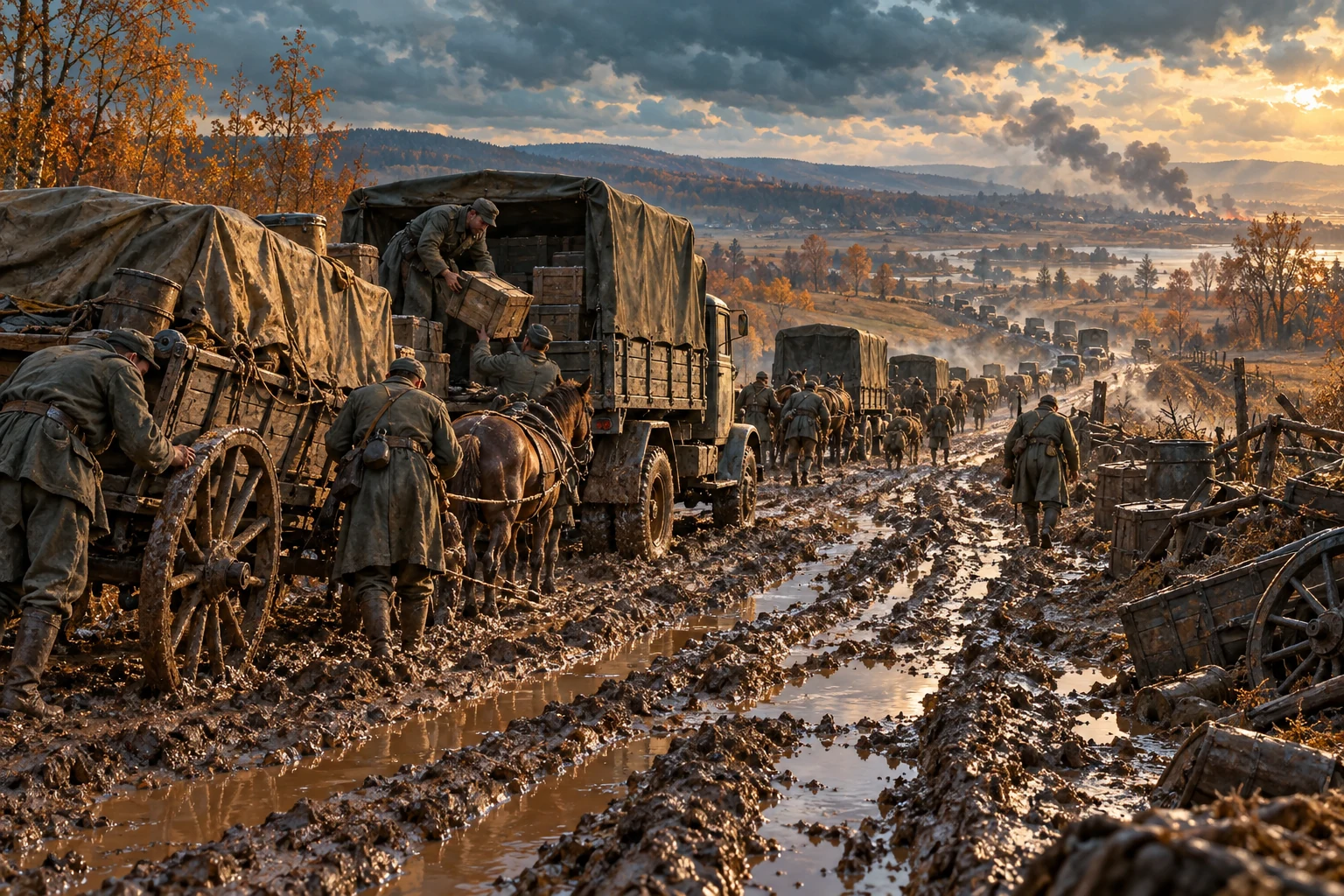
The German Federal Archives explicitly identifies the popular image of a fully motorized Wehrmacht as a legend shaped in substantial part by wartime propaganda.Horses were central to transport, hauling supplies and heavy weapons.German industry could not produce enough vehicles for full motorization, while fuel supply imposed further limits.[2]
This changes the picture.Behind the tanks were animals that needed food, rest, and care.The impressive parts of the force depended on less visible systems with very real limits.
On the Eastern Front, poor roads, railway difficulties, and the strain on horse-drawn transport complicated supply.Historian Jeff Rutherford describes these problems in an interview with the National WWII Museum.He also explains that German forces took food from Soviet civilians, within a wider war of occupation and deliberate starvation.Logistical difficulties were entangled with criminal policy; they do not excuse it.[3]
Food, equipment, and suitable clothing were practical necessities that command structures could not conjure into existence.An account published by Ohio State University’s Origins project notes the shortage of winter clothing and equipment among German forces approaching Moscow in 1941, alongside the Soviet forces that defeated them.[4]
The importance of ordinary trucks
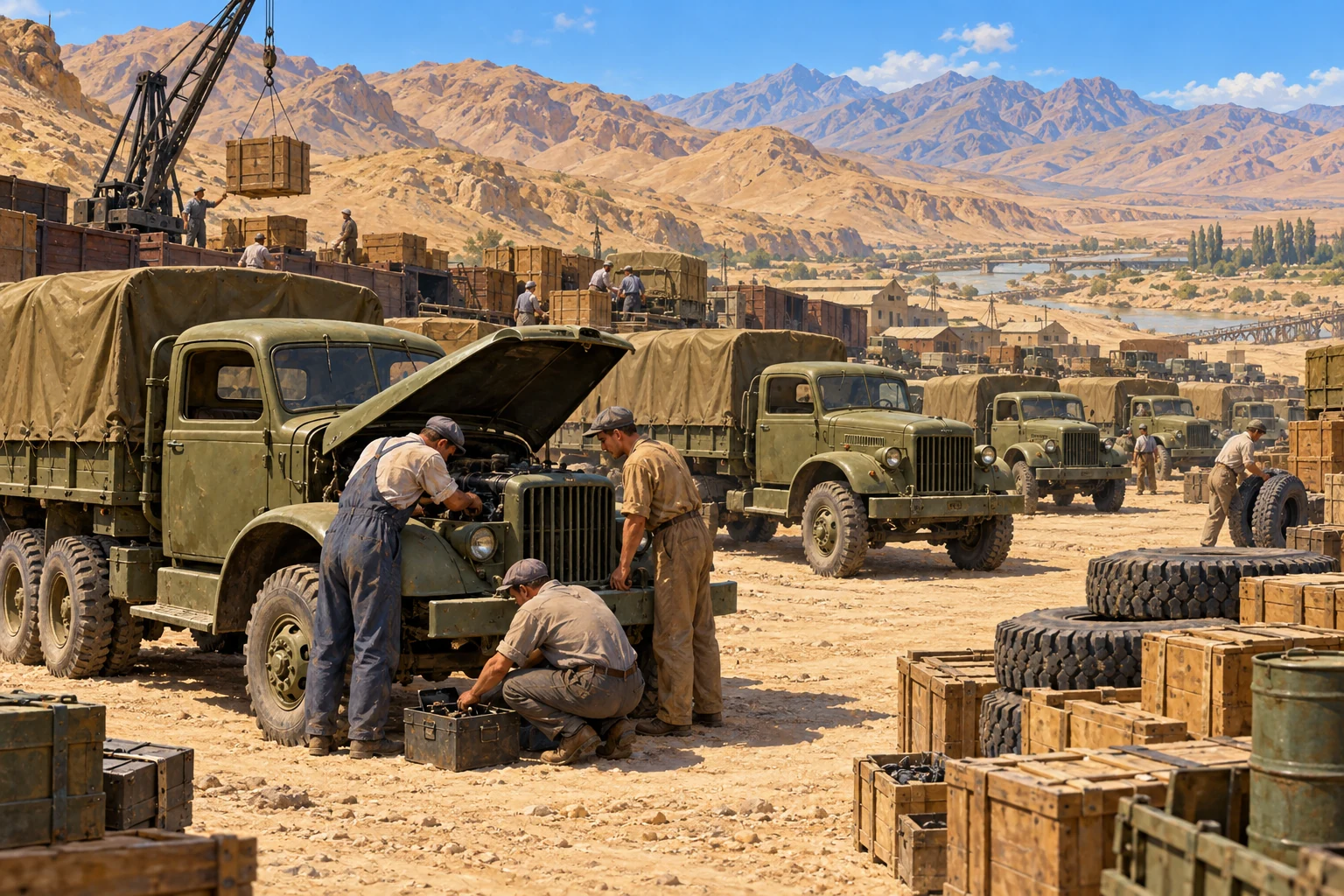
The comparison with Soviet mobility is revealing.American Lend-Lease supplied the Soviet Union with hundreds of thousands of motor vehicles.The contemporary U.S. report to Congress for the period ended September 30, 1945, lists 375,000 trucks and 52,000 jeeps.Thus, “over 400,000 trucks and jeeps” is more precise than treating the whole total as trucks.[6]
Those vehicles helped carry supplies and sustain Soviet movement over enormous distances.The National WWII Museum emphasizes their importance to the later offensives.This does not mean the entire Red Army became mechanized, or that American aid alone explains victory.It means that practical transport capacity deserves a place beside combat strength when we assess how armies actually functioned.[7]
When survival consumes the means of movement
The fate of horses offers a particularly stark example of a system under extreme pressure.At Stalingrad, an eyewitness account reproduced by U.S. Army University Press describes horses being slaughtered for food and starving soldiers cutting meat from frozen carcasses.[5]
Where transport animals are consumed, a force loses part of its capacity to move supplies and equipment.That is the practical contradiction that strikes me: an immediate need can consume something essential to meeting tomorrow’s needs.
Yet this cannot explain the German defeat on its own.The Stalingrad catastrophe involved Soviet encirclement, failed resupply, and command decisions that prevented a timely withdrawal.Horse consumption belongs within that larger collapse, as a consequence of desperation and a further loss of capacity.It is not a single-cause explanation for an entire war.[5]
What I mean by ranks
When I use ranks in my company, I mean them as an organizational metaphor.They describe roles and responsibilities.They do not express ideological allegiance, and they should never be read as admiration for Nazi rule or its crimes.
The historical lesson is more demanding than simply borrowing the appearance of discipline.A structure must be judged by what it actually enables, what it fails to provide, and how it treats human beings.An elegant diagram tells us very little about any of those things.
My grandfather’s tattoo brings this reflection back to its starting point.People cannot be reduced to positions in a system.Organization deserves careful study, but it never deserves exemption from moral judgment.Responsibility is the test.
Sources and historical context
- United States Holocaust Memorial Museum: The Role of the German Military in the Holocaust.
- German Federal Archives: Horses in the Wehrmacht and Waffen-SS (German-language archival overview).
- The National WWII Museum: Immeasurable Brutality: An Interview with Jeff Rutherford.
- Origins, Ohio State University: Operation Barbarossa.
- U.S. Army University Press: The German Debacle of Stalingrad, Parts I and II (retrospective participant account; used for the specific account of conditions in the encircled army).
- U.S. Foreign Economic Administration, via the Federal Reserve Bank of St. Louis: Twenty-First Report to Congress on Lend-Lease Operations, period ended September 30, 1945.
- The National WWII Museum: Lend-Lease to the Eastern Front.
The family detail is the author’s own account. The sources provide historical context; they do not independently document his grandfather’s experiences.
Chanan Zevin