
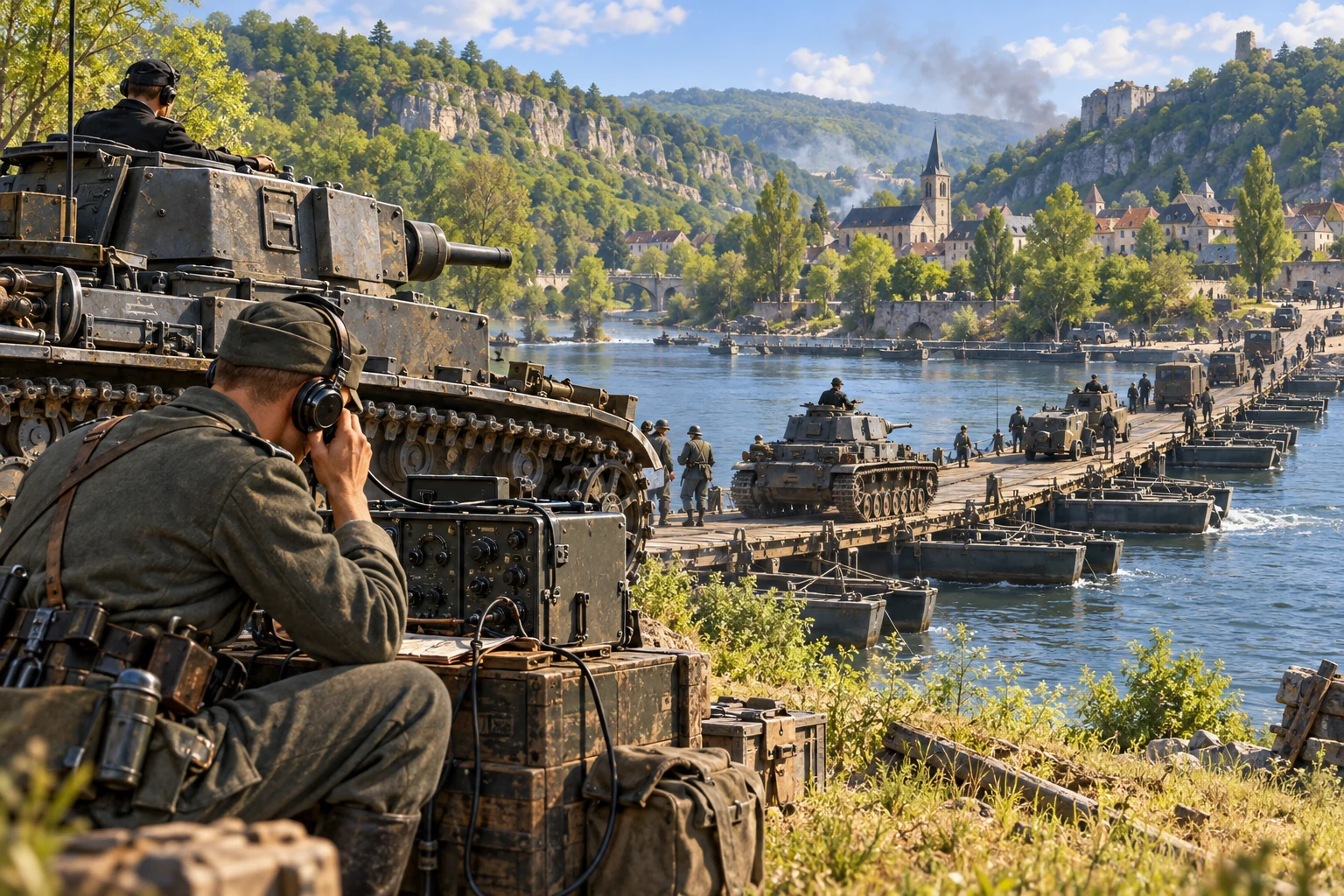
A tank is a machine.An armored formation is a relationship between machines, people, information, and decisions.The distinction helps explain one of the twentieth century’s most consequential military defeats: France’s collapse in 1940.
Germany did not win simply by possessing more tanks or universally better ones.The Allies had more tanks in aggregate, while several French designs were formidable opponents.Germany’s advantage lay partly in turning its armored forces into a coordinated operational system.Radio was an essential connection within that system.But communications alone cannot explain the campaign.[1]
The advantage between the tanks
Think of a tank encountering resistance.Its gun and armor determine what it can do immediately.Communications help determine what the formation can do next: redirect movement, coordinate supporting units, or exploit an opening before the defender responds.
German armored forces were substantially better equipped for radio communication than their French opponents.French tanks did have radios, so the familiar claim that they had none is incorrect.Distribution was uneven, however, and equipment was much less widespread.The important contrast is the effectiveness of communication across formations, rather than a simple division between armies with and without wireless technology.[2]
Here, a modern metaphor becomes useful.German armored formations can be imagined as a neural network: connected elements responding to information from elsewhere in the system.This is an analogy, not a claim that they operated like artificial intelligence.Orders still moved through military hierarchies; information remained incomplete; commanders disagreed.The metaphor’s value is narrower: connections can change what a collection of individually limited components can accomplish.
Guderian, Rundstedt, and the system
The officer associated with a signals background and advocacy of radio-enabled armored warfare was Heinz Guderian.Gerd von Rundstedt commanded Army Group A, which carried the principal offensive through the Ardennes; Guderian commanded XIX Corps, a major spearhead at Sedan.Confusing their roles turns a complex institutional development into an inaccurate story about one commander installing radios.[3][4]
Guderian’s thinking also went beyond tanks.He emphasized mechanized infantry, artillery, engineers, and supporting services capable of accompanying armor.Wireless communication mattered because it supported this larger conception of coordinated movement and combat.A radio could transmit an order; trained formations and suitable organization made that order executable.[3]
Better equipment was not enough
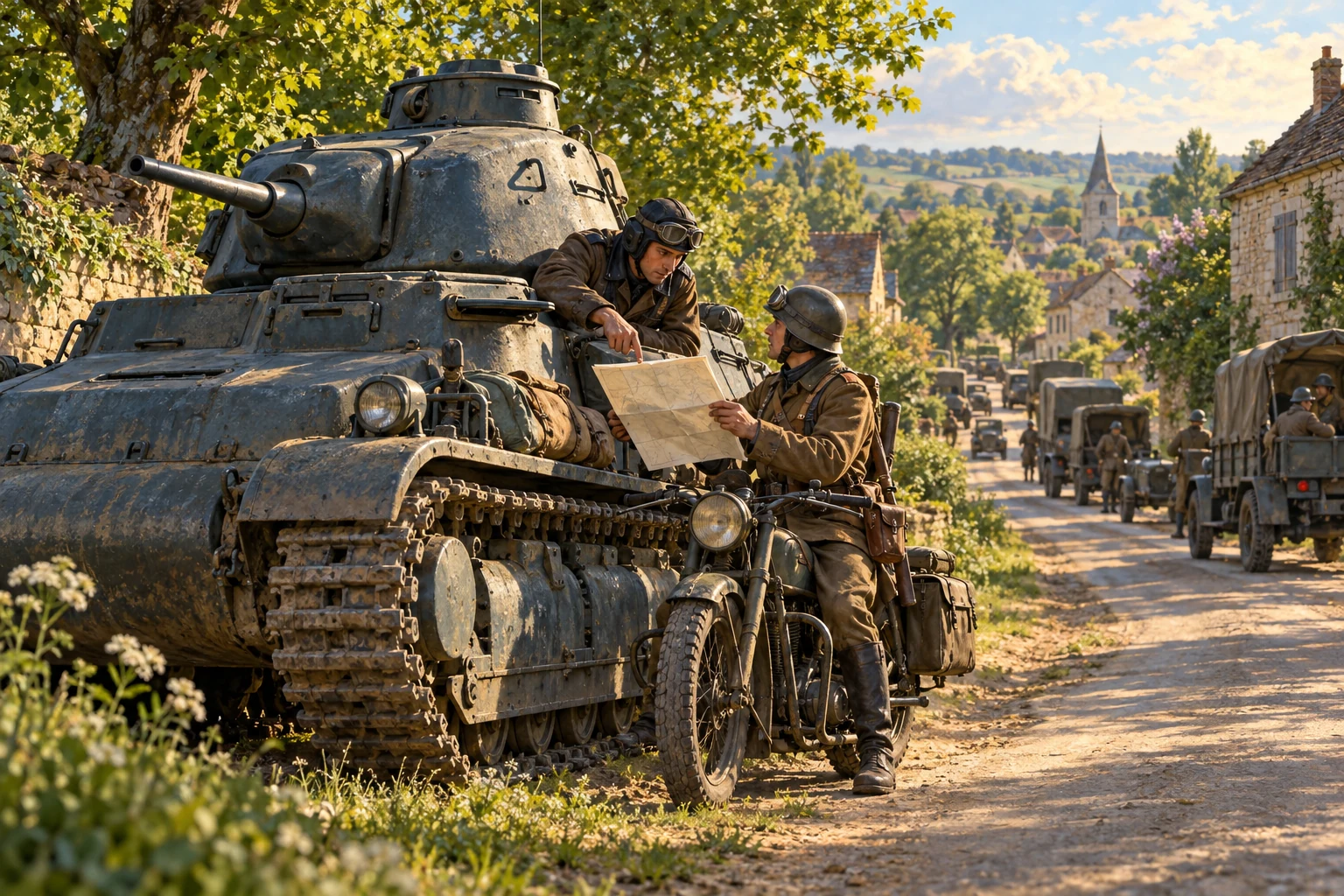
The French SOMUA S35 illustrates why technical comparisons require care.The Tank Museum describes it as one of the most highly regarded designs of its time.Yet its one-man turret imposed several jobs on the commander, including operating weapons and controlling the tank.Strong protection and armament did not remove that human bottleneck.[5]
Likewise, saying that France had “better tanks” treats a varied inventory as a single machine.Overall tank totals also obscure availability, concentration, and purpose.France possessed armored and mechanized formations; it had not assigned every tank to isolated infantry support.Nevertheless, Germany concentrated powerful mobile formations at its chosen point of attack, creating a local advantage that aggregate inventories could not capture.[1][6]
Why the breakthrough became a catastrophe
The operational setting made these differences decisive.As leading Allied formations advanced into Belgium, Germany’s main thrust passed through the Ardennes toward the Meuse.The attack struck a vulnerable part of the Allied deployment rather than attempting to batter through the strongest Maginot defenses.[1][6]
Sedan was not simply a tank duel.Infantry crossed the river before German tanks could exploit the bridgehead.Air support, supporting arms, and the subsequent movement of armor belonged to the same sequence.The breakthrough then became a race into the Allied rear.Headquarters, supply facilities, and communications came under threat, making an already difficult recovery progressively harder.[6][4]
That is where tempo mattered.A defender needs time to understand a penetration, issue orders, assemble forces, and counterattack.Rapid exploitation can make the situation change before that sequence is complete.German communications helped sustain movement while Allied command arrangements and deployment made a coordinated response harder.[1][2]
Yet victory was not inevitable.Congestion, bridge-building delays, supply requirements, and disagreements among German commanders remained real constraints.The British official history records both operational friction and the fuel and repair support needed by advancing formations.Radios did not abolish geography or logistics.[4]
France’s defeat therefore offers a systems lesson rather than a technological miracle story.Weapons acquire much of their effectiveness from the institutions that connect and employ them.In 1940, communications, concentration, combined arms, surprise, and command decisions reinforced one another with catastrophic consequences for France and occupied Europe.The most revealing question is not only what each tank could do.It is what the army could make its tanks do together.
Sources
- National Army Museum, “Defeat in the West, 1940”. Campaign overview; Allied aggregate tank advantage, German concentration, command methods, and Allied deployment.
- U.S. Army, ARMOR, November–December 1993. Discussion of radio distribution and command-and-control differences in the 1940 campaign.
- U.S. Army, ARMOR, January–February 1994, book review section, printed p. 52. Guderian’s signals background, radio advocacy, and emphasis on mechanized supporting arms.
- L. F. Ellis, British official history, The War in France and Flanders 1939–1940, “The Planning and Conduct of the German Campaign,” pp. 333–348. Command responsibilities, combined operations, logistics, friction, and command disagreements. Digitized by HyperWar.
- The Tank Museum, “SOMUA S35”. Vehicle design and the commander’s workload in the one-man turret.
- Kris Thompson, U.S. Army ARMOR, “Trends in Mounted Warfare,” July–September 2013. Concentration, French armored organization, the Sedan infantry crossing, and disruption of rear-area facilities. Professional military analysis; its broader rhetorical judgments are not adopted here.
Chanan Zevin